For the First Time in Turkey, Primary and High School Students Will Follow Their Lessons Through an E-Textbook
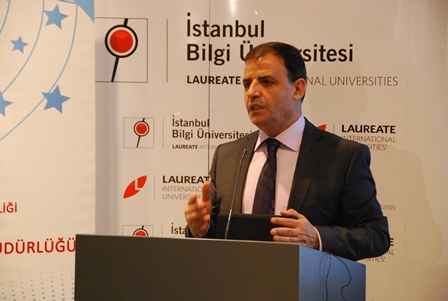
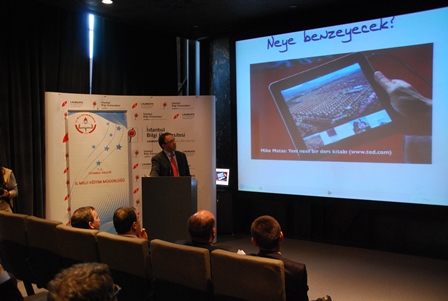
The press launch of the project titled “Digital European Union: A Turkish E-Book for Primary and High School Students”, carried out in partnership between Istanbul Bilgi University and the Istanbul Provincial Directorate of National Education and supported by the European Commission, was held at Istanbul Bilgi University’s Santral Campus.
The event took place on Friday, 23 March, with the participation of Dr. Muammer Yıldız, Director of National Education of Istanbul; Prof. Dr. Remzi Sanver, Rector of Istanbul Bilgi University; and Prof. Dr. Ayhan Kaya, Director of the European Institute at Istanbul Bilgi University. The speakers provided detailed information about the project.
“An important step towards one of Turkey’s key objectives”
In his opening remarks, Dr. Muammer Yıldız emphasized that the project aligns with the Ministry of National Education’s current reform initiatives.
“When this project was proposed to us, we accepted it without hesitation,” he said. “The Ministry is entering a new phase with curriculum reforms and the FATİH Project. Bringing these components together through such a project is highly valuable for us.”
“A successful example of international collaboration”
Rector Prof. Dr. Remzi Sanver highlighted the university’s commitment to social responsibility and international cooperation.
“This project stands out both for its educational value and as an exemplary model of collaboration between academia and public institutions,” he noted. “With the support of the European Commission, our work gains vitality and also contributes to overcoming negative perceptions within society.”
E-Book to present EU topics through clear, visual, and accessible content
Project coordinator Prof. Dr. Ayhan Kaya stated that the e-book will be based on a simplified version of Introduction to the European Union: History, Institutions, and Policies, published by Bilgi University Press.
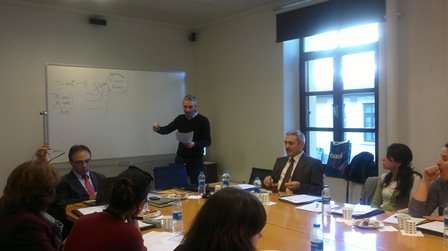
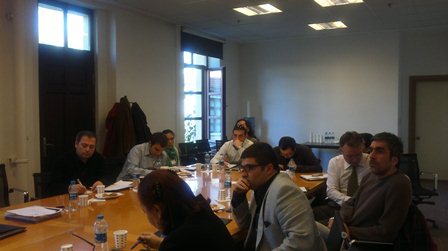
“Our goal is to encourage young people’s engagement with EU processes,” he said. “By working together with teachers, academics, civil society organizations, and experts, we are shaping the content through a structured process including preparation, piloting, and evaluation.”
Kaya added that the pilot phase will involve 15 teachers and 150 students. The e-book will be revised based on feedback, and the final results will be presented to the public at a concluding conference.
To be completed by the end of 2012, fully compatible with tablets
Launched in January 2012, the project will be completed in December 2012.
The e-book will be compatible with tablet computers distributed within the Ministry of National Education’s FATİH Project and will also be available for free download on a dedicated website. A teacher’s guide will likewise be prepared for educators who wish to use the e-book in their classrooms.
Once finalized, the e-book will introduce students to:
-
the history, institutions, and enlargement of the EU,
-
economic integration and key EU policies including agriculture, education and youth, social policy, competition, and consumer protection,
-
EU citizenship, participatory and pluralist democracy, civil society and the European public sphere,
-
media and the EU, globalization, and debates on Europe’s borders.
Through the use of videos, images, and audio materials, the digital format aims to make the resource more appealing and engaging for students.