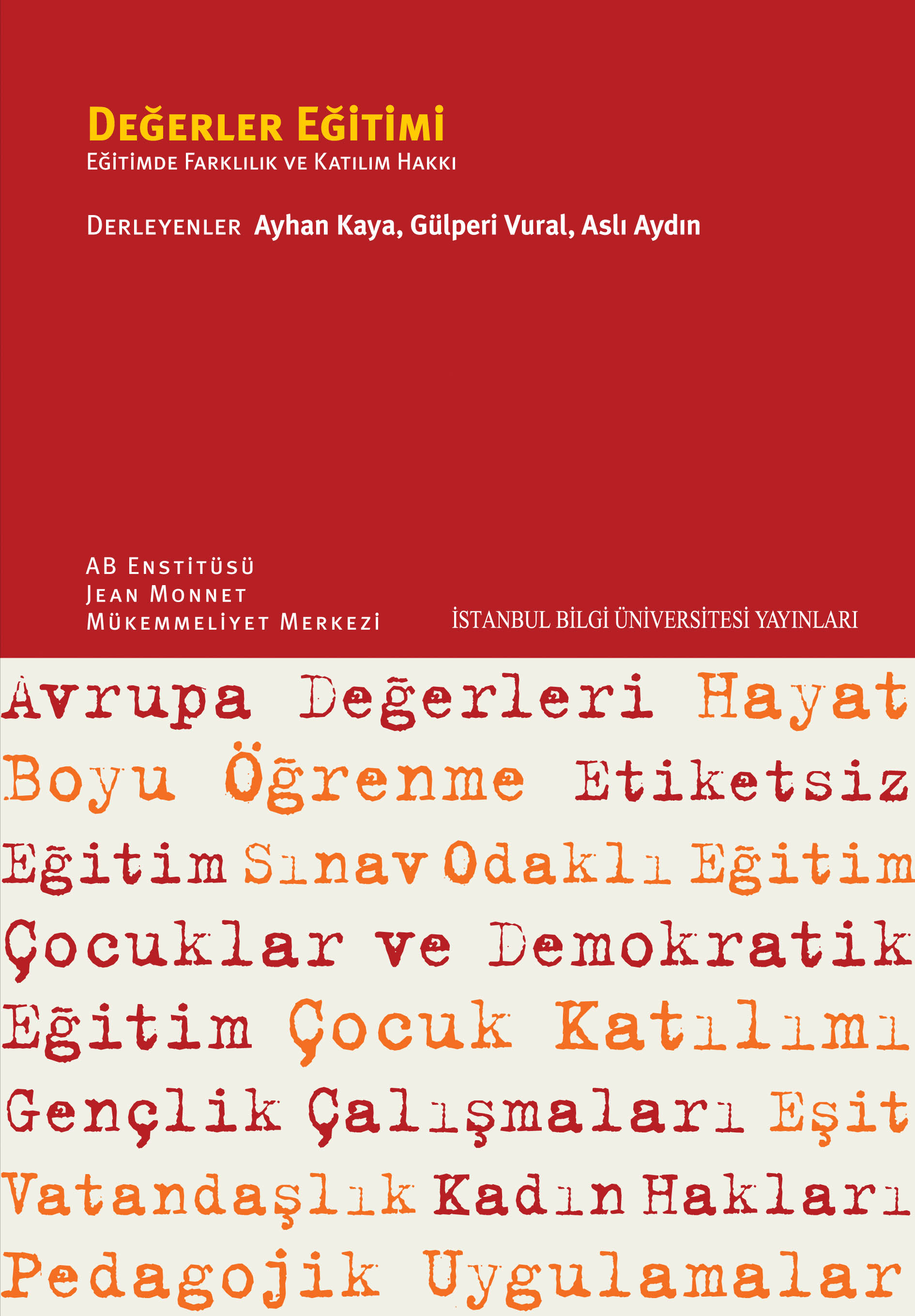
Book Announcement: “Values Education: Diversity and the Right to Participation in Education”
This book is the final output of the “European Values at School” Project, conducted by the European Institute of Istanbul Bilgi University between 2013 and 2016, a project that granted our Institute the title of Jean Monnet Centre of Excellence. Funded under the EU Erasmus+ Programme, the project organised a series of Teacher Seminars as well as EU-focused seminars for high school students.
In addition to these activities, an undergraduate course titled IR 479 Islam and the West: Bridging the Gap (IR 469 Islam and the West: Bridging the Divide) was developed within the Department of International Relations and offered during the Fall semesters for three consecutive years. The course attracted nearly 300 students, drawing strong interest from both local and international participants. All project outputs are available at:
http://eu.bilgi.edu.tr/tr/programs/jean-monnet-okulda-avrupa-degerleri/
The book consists of five main sections, each featuring valuable contributions from distinguished scholars:
-
European Values
-
Findings of the Teacher Survey
-
Children and Democratic Education
-
Gender and Equal Citizenship
-
Alternative Pedagogical Practices
In the first section, Uwe Krause presents the European Values Atlas, with his English contribution translated into Turkish by Dr. İlkay Südaş.
The opening article of the second section, authored by Ayhan Kaya, presents the findings of the quantitative survey conducted with teachers at the outset of the project. The following two articles by ÖRAV researchers Sonnur Özel, E. Ekin Çapar and Öznur Toper evaluate the results of the “Education Without Labels” project. Another original study by Hakan Yücel and Demet Lüküslü discusses fieldwork findings with physical education teachers.
In the third section, Fethiye Erbil examines perceptions of childhood and child participation, while Ayşe Beyazova and Melda Akbaş analyse the challenges Syrian refugee children face in accessing educational services in Turkey, based on their own fieldwork. The section concludes with A. Zeynep Kılıç and Gözde Durmuş, who explore children’s participation in school decision-making processes.
The fourth section is dedicated entirely to gender. Since the beginning of the Jean Monnet Centre of Excellence project, we have focused on themes such as gender, children’s rights, environmental issues, education, cultural diversity, migration and mobility, contributing to greater awareness on these topics. In this section, Pınar Uyan-Semerci discusses debates on women and equal citizenship through the lens of justice.
The final section presents two examples of alternative pedagogical approaches. Yörük Kurtaran analyses how youth centres and mobility opportunities can serve as alternative schools for young people. The concluding chapter, authored by Ayhan Kaya, draws on fieldwork with youth of Turkish origin in Germany to explore how rap music and graffiti can be used as alternative learning pedagogies.